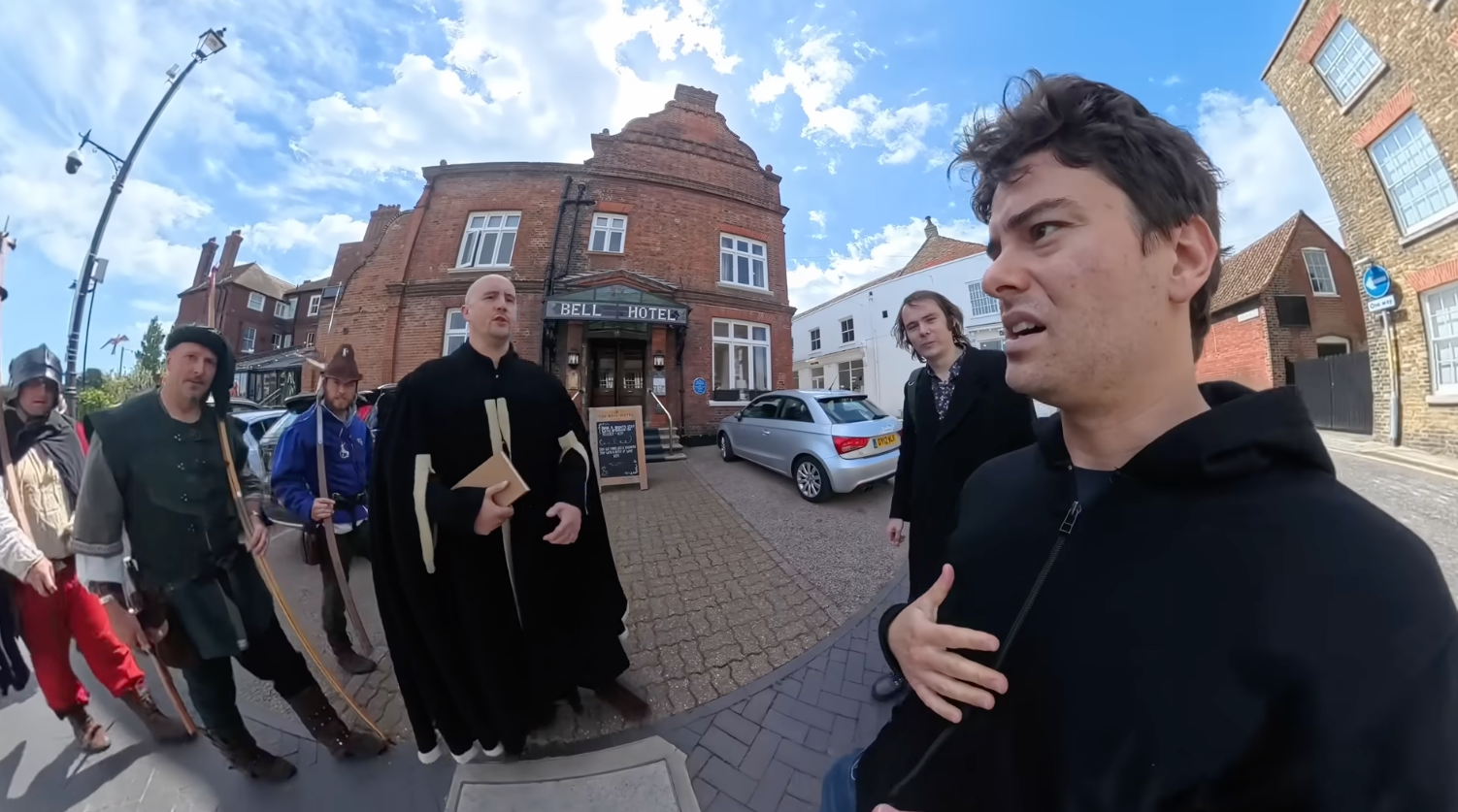
I’ve been browsing YouTube in my spare time and came across a video featuring two lads, including Simon Roper (I’m his long-time follower by the way). They travel around a small English town and attempt to converse in Middle English with the locals. Watch it on YouTube.
Initially, it was captivating but occasionally felt gimmicky and cringe-worthy, as we, as modern people, might say. I don’t mind that. I’m quite cringeworthy myself and find their interest with ancient languages fascinating. They even mention Latin in the video.
Old languages hold a special place in my heart. That era, particularly the 1200s and 1300s, is incredibly intriguing to me.
Mighty 1200s-1300s
What strikes me most is that the ideas were already there. The hunger for them, too. Scholars in Paris and Oxford were rediscovering Aristotle through Arabic translations, merchants in the Italian city-states were inventing the bookkeeping that would one day underwrite empires, and poets were quietly deciding that their own tongues (not Imperial Latin) were worthy of serious thought. Dante wrote his Comedy in Tuscan. Chaucer would soon do the same for English. The local was no longer the language of the kitchen; it was becoming the language of ambition and growth.
And yet everything moved at the speed of a horse and a scribe. A single brilliant manuscript could sit in one monastery for a generation before anyone two valleys over heard of it. A good idea couldn’t scale because the infrastructure to spread it simply didn’t exist. Copying a book took months, if not years. News travelled by foot.
That’s the part I keep turning over. These weren’t primitive people waiting for cleverer ones to arrive. They were us. Stuck with a logistics problem so fundamental that it would take another century and a German goldsmith to solve it. And perhaps that’s why the 1200s and 1300s feel so alive to me. It’s the sensation of standing right at the edge of something enormous. Close enough to sense it, too early to touch it. Which, if I’m honest, is a feeling anyone who has ever built things will recognise.
Old Far North
And while all of this was stirring in Europe, on the opposite edge of the same century something quieter and far harsher was taking place. As Genghis Khan welded the steppe into a single war machine in the early 1200s, the tribes who wouldn’t bend to it had to run. Among them were the Turkic-speaking ancestors of the Sakha, herders and ironworkers from around Lake Baikal who packed up their tools and cattle and pushed north. Further north than any pastoralist had any business going, until they reached the middle Lena (Lena is a modern Russian name and its origin is debated but for simplicity I’ll use it here). They chose it because the alternative was the Imperial storm at their backs.
What I find almost unbearably human is what that flight made of them. The Empire chase the pre-Sakha north and pressed a hardness into them that never left. That warrior temper still echoes in the Olonkho, the great epic of bootur-heroes the people carried in their mouths centuries before anyone wrote it down. And then came the real struggle, the one no army could fight for them. Keeping animals bred for the open Taiga alive through winters of fifty and below, in permafrost, in the long dark. They had to reinvent herding itself at the very edge of the liveable world. That they managed it! There are horses, cattle, ironworking, and a living Turkic tongue thriving in Yakutia to this day. That alone still strikes me as one of the most stubborn, improbable feats of endurance the medieval world ever produced.
And most of Europe never even knew it happened…